The starting point
I grew up in Brasília, a city quite literally designed for the car. The Plano Piloto was planned for 500 thousand inhabitants by the year 2000, with wide avenues, neatly zoned sectors and distances that make sense through a windshield and become punishing walks for anyone on foot. In the 2022 census, Brasília ranked as the third largest city in Brazil. The city never froze in time, it simply outgrew its own blueprint, and the people who feel that every day are the ones riding buses across dozens of kilometers between the satellite cities and the center.
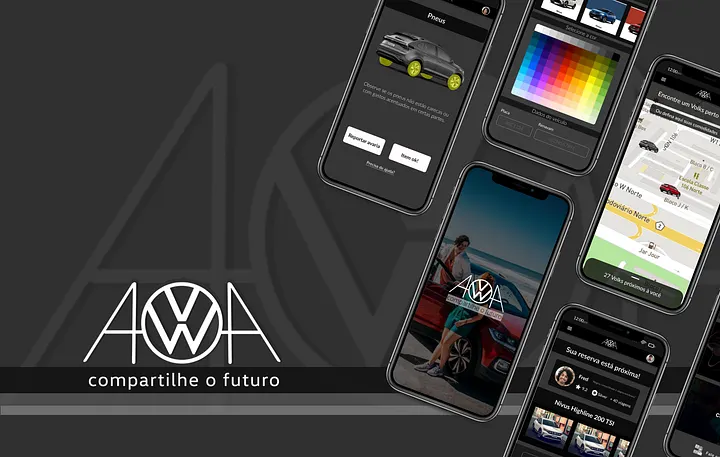
That lived friction is where AVWA came from: a conceptual mobility service where people rent cars from other people, with the safety and convenience technology can provide, backed by the credibility of a brand like Volkswagen. This case covers the service conception stage, the moment where I had to turn context into decisions before designing any flow or interface.
The question that organized everything was easy to ask and hard to answer: is owning a car actually worth it? The answer depends on income, routine and territory, and that variation is exactly where the service opportunity lives.
The challenge
Ground the conception of a P2P carsharing service in evidence rather than hunches. That meant sweeping an entire system, from society, economy and environment to the automotive market and urban mobility, and coming out the other side with defensible service pillars: who it exists for, what problem it solves, why a carmaker should run it, and what to learn from everyone who had already tried and closed shop.
Why secondary research and benchmarking
As a conceptual project, I had no access to Volkswagen's internal data and no customer base to interview. My method decision was to work with what is public and verifiable: market studies, press coverage, competitors' websites and FAQs, hands-on navigation of their apps, and consumer feedback on platforms like Reclame Aqui. Good desk research does not replace primary research, but it is what defines the right questions for the stages that follow.
Mapping the system
The investigation moved in circles that got progressively closer to the user. I started with behavior: an OECD study showed that during the 2010s, average leisure time fell in 8 of the 13 monitored countries. A mobility service does not compete only for people's money, it competes for their scarcest resource, which is time.
The second circle was the sharing economy, already moving around US$ 15 billion a year worldwide on three pillars: trust, conscious consumption and unique experiences. The strongest evidence for the thesis came from the Shared Mobility study by the University of California: one shared car removes, on average, 9 to 13 vehicles from the streets, and 25% of carsharing users sold their own car while another 25% postponed buying a new one. Access was demonstrably replacing ownership.
The third circle was the brand. Volkswagen, the world's largest car manufacturer, was coming out of a strategic repositioning driven by sustainability and innovation: the WeShare sharing service in Europe (VWmove in Brazil), the WeConnect Go app connecting vehicles to the internet of things, and a plan to invest 3.5 billion euros in its digital presence through 2025. A line from CMO Jochen Sengpiehl summed up the shift AVWA proposed to accelerate: the company was no longer primarily concerned with products, but with the people who live with them.
The last circle was the most important and the most uncomfortable one: who actually gets to choose the car in Brasília? The study Como Anda Brasília showed that the capital has the highest per capita income in the country and, at the same time, the second most unequal income distribution. The segmented data tells the rest: walking and bus rides are predominantly female, the Black population depends on buses at nearly twice the rate of non-Black residents, and Black women living in the periphery are the group most underserved by public transport policy. The conclusion I carried into the service design was blunt: urban mobility is intimately tied to social exclusion, and a service that ignores this is born short-sighted.
Process and role
I worked solo across every front of this stage, organized in five phases:
- Broad secondary research. I mapped concepts, scenarios and trends across society, economy, environment, the collaborative economy, the automotive market and urban mobility, always from citable public sources.
- Reading the territory. I analyzed Brasília as a case study: the modernist logic of the Plano Piloto, the unplanned growth of the satellite cities, and the structural drivers of the mobility problem documented in the literature, from the misalignment between urban planning and transport systems to the lack of permanent infrastructure funding.
- Inequality cuts. I crossed the income, gender and race data from the district household survey to understand who gets to choose how they move and who simply endures whatever exists.
- Market benchmarking. I compared the initiatives closest to the proposal on service format, amenities and cost: MoObie and Ominicar as P2P intermediaries, the pioneer Fleety, Pegcar with its roughly 30 thousand users and the insurance product it created with Mapfre, and the active players, from Turbi with 1,700 vehicles and 800 pickup points in Greater São Paulo to Turo, with 130 thousand cars listed across 4,700 cities.
- Synthesis and model decision. I contrasted the two viable business models, B2C with a proprietary fleet and P2P between individuals, and made the case for P2P: it serves people without a car and, at the same time, turns an owner's idle vehicle into a source of income. The sales argument fits in one sentence: your car can pay for itself.
What this stage delivered
The outcome of this stage was not a screen, it was the backbone of the service. First, the thesis: the market exists, and it is stratified by income, race and gender, which makes easier access to cars a matter of social impact and not just convenience. Second, the legitimacy: VW had the financial resources, brand strength and innovation-driven strategy to pioneer P2P carsharing in Brazil. Third, the reframing: the car stops being a consumer good and becomes a tool for getting around and for earning income.
9 to 13
cars taken off the streets by every shared car
89%
of Brazilians who tried collaborative services were satisfied
4M
privately owned cars in São Paulo alone, versus 1M in rental fleets
2
business models compared before choosing P2P
The benchmarking also delivered something I consider more valuable than the list of competitors: the reasons carsharing had already failed in Brazil. Fleety shut down in 2017, Pegcar and MoObie went offline, and the patterns repeat: difficulty raising investment and sustaining working capital, the cultural shift required to rent a stranger's car, prices that matched traditional rental companies, and the absence of an integrated solution with flexible pickup, minimal bureaucracy and efficient support. Every cause of death became a design requirement for the next stages of AVWA.
What I learned
- Service design starts far from the screen. AVWA's most structural decisions, like the P2P model and positioning the car as a source of income, came from reading context, not from wireframes. Today, as a Product Designer, this is the part of the process I defend hardest in any product.
- Inequality is project data, not a footnote. The gender and race cuts changed the project's core question, from "how do we make car rental easier" to "who does this service need to include to be worth existing". Without that crossing, AVWA would be just another convenience app for people who already have choices.
- The competitor graveyard teaches more than the living. Studying why Fleety, Pegcar and MoObie closed produced more concrete requirements than any feature list from active competitors. Failure benchmarking should be standard practice.
- I would listen to people sooner. The secondary research ran deep, but today I would interleave it earlier with primary research to test the behavioral hypotheses instead of just stacking them. That was exactly the job of AVWA's quantitative research stage that followed, and the lesson stuck with everything I designed after it.